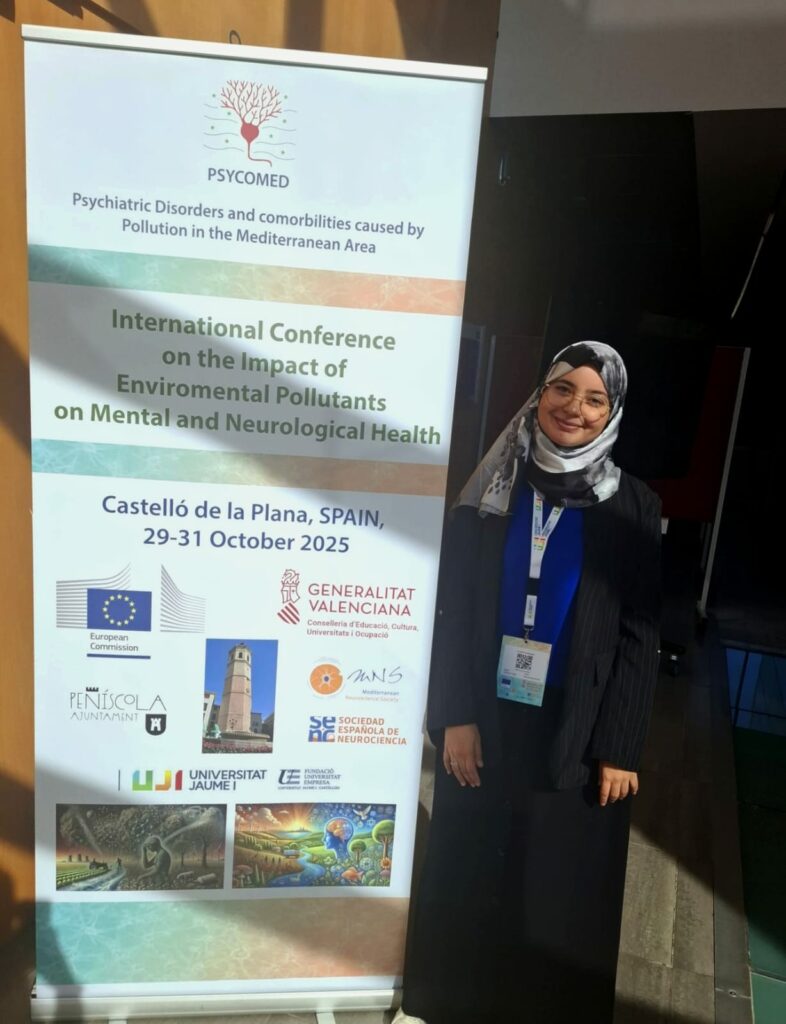
Interview with Ihsane Ait Mansour from University Cadi Ayyad (Morocco), on her current secondment under the supervision of prof. Francisco E. Olucha.
First of all, can you tell us more about yourself? Where are you from, what is your university background?
My name is Ihsane Ait Mansour, and I am originally from Morocco. I studied Biology before completing a Master’s degree in Neurosciences through the EMN program at Cadi Ayyad University in Marrakech. Currently, I am in the fourth year of my PhD, where my research focuses on the medial cingulate cortex (MCC) and its role in controlling aggressive behavior induced by social isolation.
Why did you choose this career path? What is your interest about science?
I chose neuroscience because I have always been fascinated by the brain and how it regulates complex behaviors. My curiosity about the mechanisms behind aggression and social interaction motivated me to pursue this path. What interests me most about science is its ability to transform questions into knowledge and solutions. In my case, I am particularly drawn to how therapeutic interventions, such as environmental enrichment, social exposure therapy, or oxytocin, can modulate brain function and behavior.
Can you tell us more about your mobility? Where did you go, for how long? On what kind of research were you working on? Who did you work with? Are you planning other secondments?
I am currently in my third month of a six‑month mobility at Universitat Jaume I (UJI) in Spain, under the supervision of Professor Francisco E. Olucha Bordonau. My project here investigates how social isolation progressively induces behavioral and morphological alterations in the MCC, using different periods of isolation in animal models. This experience allows me to deepen my understanding of how prolonged isolation impacts brain structure and function, while also expanding my methodological skills. I am also planning a second secondment to complete my investigation through direct manipulations of the MCC.
Same question, but for people who don’t understand a thing about neuroscience (#PsyCoMedfordummies)
I study how being alone for long periods affects the brain and behavior. In particular, I look at a brain region called the MCC, which is important for controlling aggression. By testing different ways of reducing the negative effects of isolation, like giving animals more stimulating environments, social contact, or oxytocin. I hope to find strategies that could help keep the brain healthy and reduce aggressive behavior.
What will your research bring to people and to society in general?
My research contributes to understanding how social isolation affects the brain and behavior, which is highly relevant in today’s world where isolation can occur in many contexts. By identifying how the MCC changes under these conditions and testing possible interventions, my work could inform strategies to prevent or reduce aggression and improve mental health. Ultimately, this knowledge may help design better therapeutic approaches and promote healthier social environments.
How do you feel being part of a MSCA Staff Exchange project? What are the benefits of such mobility? What are the results of your secondment?
Being part of the MSCA Staff Exchange project is a valuable opportunity. It allows me to collaborate internationally, learn new techniques, and broaden my scientific perspective. Working at UJI has already enriched my PhD project by giving me access to new methodologies and a stimulating research environment. Beyond the scientific benefits, this mobility also fosters personal growth and cultural exchange.
Do you already have future projects you want to share with us?
Yes, I am planning a second secondment that will allow me to explore how direct manipulation of the MCC using advanced techniques such as optogenetics and chemogenetics can affect mice behaviors. This project will help me better understand the causal role of the MCC in aggression and social interaction, and could open new avenues for therapeutic interventions.
Do you have a recommendation/an advice for future potential MSCA fellows?
My advice would be to embrace mobility as both a scientific and personal journey. Be open to new ideas, cultures, and collaborations, and don’t hesitate to step out of your comfort zone. These experiences will not only strengthen your research but also broaden your horizons and enrich your career.