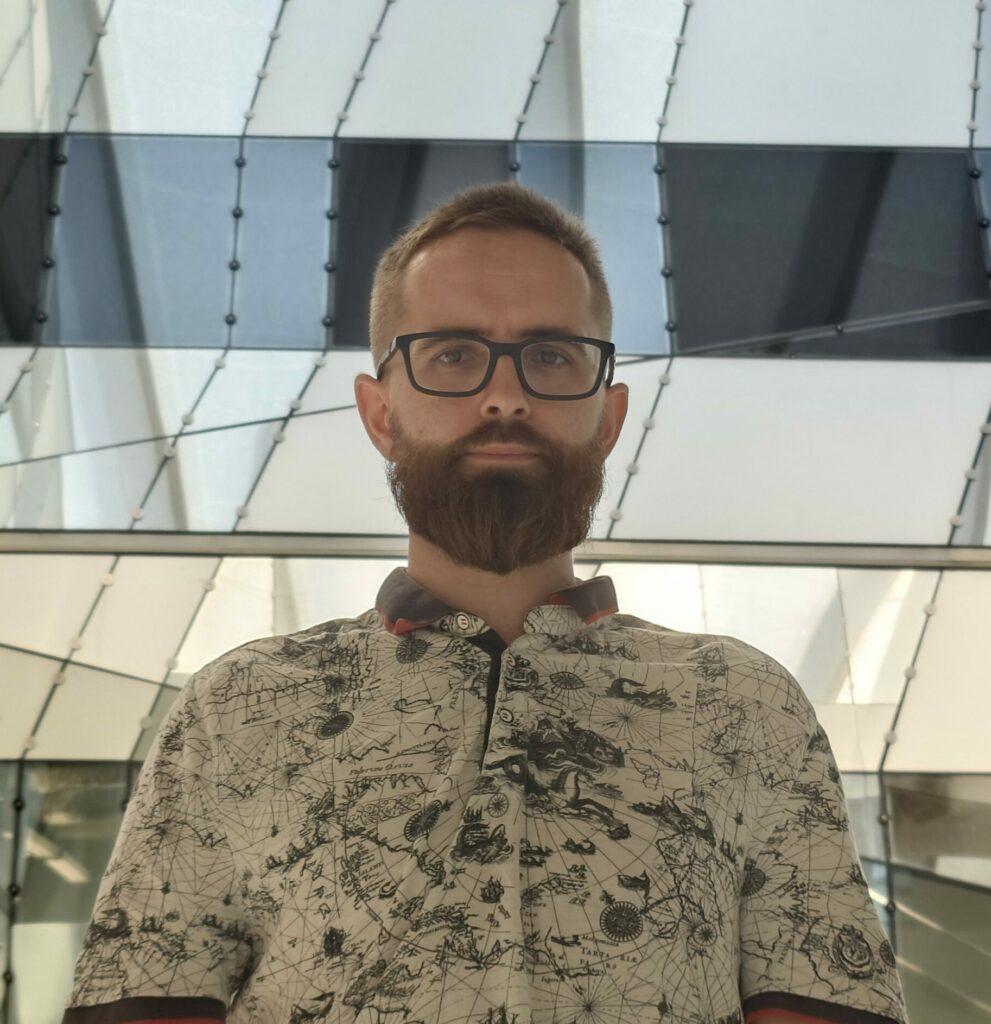
Interview with Patryk Sambak from Jagiellonian University in Krakow (Poland) on his secondments within the PsyCoMed project.
First of all, can you tell us more about yourself? Where are you from, what is your university background?
I am from southern Poland, and I studied at the Jagiellonian University in Kraków, where I specialised in neurobiology from the beginning of my studies. I completed both my BSc and MSc there, and later also my PhD in biological sciences.
My main research background is in electrophysiology, particularly ex vivo electrophysiology, but during my research, I also worked extensively with anatomical and immunofluorescence techniques, behavioural experiments, as well as optogenetic and chemogenetic approaches. My research has mainly focused on understanding how specific neuronal circuits contribute to behaviour and how their activity can be modified under different conditions.
Why did you choose this career path? What is your interest about science?
I have always been interested in understanding how the world around me works, from smallest scale processes to the largest structures in the universe. Among all these topics, I was particularly fascinated by the complexity of living organisms and the mechanisms that allow them to function.
When I had to choose what to study, it was quite difficult for me to decide in which direction I wanted to develop this interest further. I eventually chose neurobiology because it gave me the opportunity not only to learn how the nervous system and the organism work, but also to investigate these mechanisms experimentally. This opportunity to explore such questions myself through experiments and gain a direct, hands-on understanding of biological systems is one of the aspects of science that I value most.
Can you tell us more about your mobility? Where did you go, for how long? On what kind of research were you working on? Who did you work with? Are you planning other secondments?
My current secondment is at the Institute of Neurodegenerative Diseases in Bordeaux, where I joined Marc Landry’s team at the University of Bordeaux. I arrived in July 2026 and I will stay until the end of December.
The research in which I am involved here focuses mainly on neuropathic pain in rodent models. We are interested not only in the sensory aspects of pain itself, but also in how chronic pain can affect mood and behaviour.
An important part of this research is testing different strategies that may alleviate these symptoms. When we find that a particular intervention changes pain-related or behavioural symptoms, it can also help us better understand the mechanisms involved. In the longer term, this kind of knowledge may contribute to identifying new therapeutic strategies for patients suffering from chronic pain.
I am not planning any further secondments within the PsyCoMed programme. I hope, however, that the experience I gain and the results obtained during my stay in Bordeaux will be useful for my future research and help shape the next steps of my scientific work.
Same question, but for people who don’t understand a thing about neuroscience (#PsyCoMedfordummies)
In the type of research I am involved in, one of the main goals is to understand how the brain works both under healthy conditions and during disorders such as neuropathic pain. The better we understand how healthy brain functions and what changes when a disorder develops, the better we can understand the mechanisms behind the disorder.
Neuropathic pain is a type of pain caused by damage or dysfunction of the nervous system. In humans, it can occur, for example, after nerve or spinal cord injuries but also in different conditions affecting the nervous system. What is particularly important is that chronic pain is not only about the sensation of pain itself. When it persists for a long time, it can also affect mood, motivation and behaviour. In our research, we try to understand how different systems in the brain contribute both to pain perception and to the changes that may lead to low mood and depressive-like symptoms.
By studying these mechanisms, we can better understand why chronic pain affects people in so many ways and how these different symptoms may be connected.
What will your research bring to people and to society in general?
Chronic pain can persist for a long time and affect not only physical functioning but also mood, behaviour, and overall quality of life. This is why it is important to understand not only how pain itself is generated but also how prolonged pain affects the brain more broadly.
Most of the research I am involved in is fundamental research, so its effects on patients or society are not immediate. The first goal is to better understand the mechanisms involved in these changes and how they can be influenced. In the longer term, this knowledge may help identify new therapeutic approaches or improve existing treatments for chronic pain and its associated symptoms.
How do you feel being part of a MSCA Staff Exchange project? What are the benefits of such mobility? What are the results of your secondment?
For me, the MSCA Staff Exchange is a valuable opportunity to work in a different research environment and to gain experience outside my home institution.
During my stay in Bordeaux, I have been able to learn new experimental approaches and techniques, broaden my practical skills and become involved in projects that are different from those I worked on previously. The mobility has also given me the opportunity to meet researchers with different backgrounds and establish contacts that may be useful for future collaborations.
The secondment is still ongoing, so it is too early to talk about final scientific results. At this stage, the main outcomes for me are the experience I have gained, the new methods and approaches to which I have been exposed, and the opportunity to contribute to the projects carried out by the team in Bordeaux.
Do you already have future projects you want to share with us?
I would like to continue working in neuroscience, particularly on neuronal circuits involved in pain, stress, and affective behaviour. One of my main research interests is a relatively little-studied brain structure called the nucleus incertus and the neuropeptide relaxin-3, which is strongly associated with this region. Much of my previous research has focused on this system, and I would like to continue exploring the different effects of relaxin-3 signalling in the brain.
For my future research, I am particularly interested in studying this system in the context of neuropathic pain. I would like to go deeper into this topic and investigate in detail how this signalling system may influence the brain mechanisms involved in chronic pain and its behavioural consequences.
These plans are also connected with France. If I am successful in obtaining funding, I would like to continue this work during a postdoctoral fellowship in France.
Do you have a recommendation/an advice for future potential MSCA fellows?
Going abroad for a research stay can be stressful, but it is also a very good opportunity to see how research can be organised and carried out differently.
When you spend most of your time in one laboratory, it is easy to start treating certain procedures, habits, or ways of organising work as the obvious way of doing things. Only when you move to another research environment do you realise that many of these things are specific to a particular laboratory or institution. Seeing alternative approaches can also make you reconsider the methods you have used before and sometimes help you improve or refine your own procedures.
For this reason, I think it is worth being open to different ways of working and trying to learn as much as possible from the people around you. A secondment is not only an opportunity to learn new techniques, but also to experience a different research culture, different approaches to solving problems and, more generally, life and work in another country.