Interview with Sana Garrad from Université Cadi Ayyad (Morocco), on her secondment under the supervision of Prof. Marc Landry.
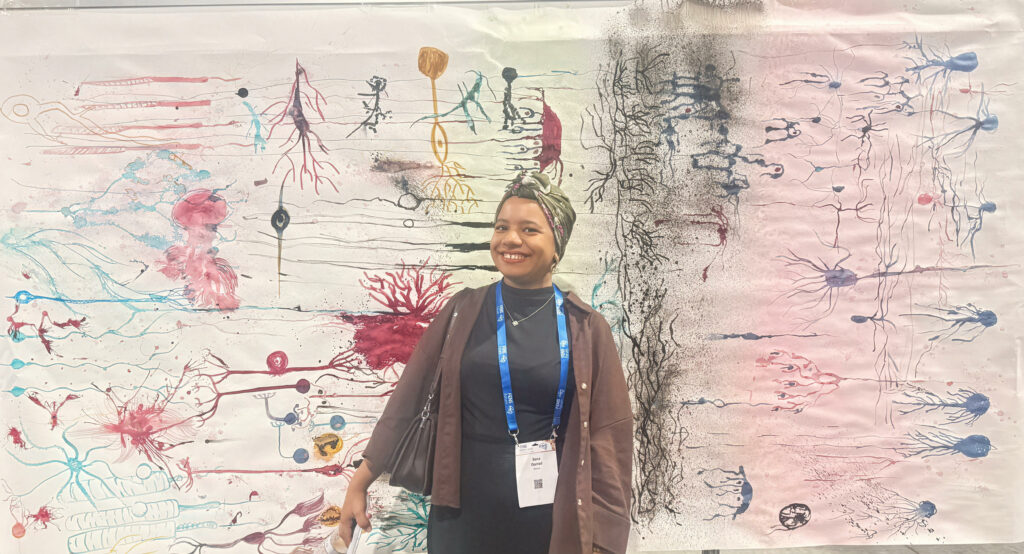
First of all, can you tell us more about yourself? Where are you from, what is your university background?
My name is Sana Garrad. I am a PhD candidate in Neuroscience at Cadi Ayyad University, Marrakech. I previously completed my Master’s degree in Neurosciences through the EMN program at the Faculty of Sciences and Techniques of Béni Mellal, Sultan Moulay Slimane University. My doctoral research lies at the interface of systems neuroscience and behavior, with a particular focus on thalamocortical circuits. I investigate the functional specialization of the mediodorsal thalamus (MD) subdivisions namely the lateral (MDl) central (MDc) and medial (MDm) parts and their respective contributions to social, cognitive, and affective behavior.
Why did you choose this career path? What is your interest about science?
I chose neuroscience because it addresses some of the most fundamental questions we can ask: how the brain perceives, remembers, decides, and shapes behavior. What drew me to this field is its unique position at the intersection of biology, medicine, and cognition it requires both experimental rigor and a broad, integrative way of thinking.I am particularly interested in how research in neuroscience combines curiosity-driven questions with a direct relevance to human health, especially in the context of neurological and psychiatric disorders. Committing to a career in this field means contributing, even modestly, to a collective effort to better understand the brain and, ultimately, to improve the lives of people affected by its dysfunctions. It is this combination of intellectual depth and concrete impact that made neuroscience the natural path for me.
Can you tell us more about your mobility? Where did you go, for how long? On what kind of research were you working on? Who did you work with? Are you planning other secondments?
My mobility took place at the Institute for Neurodegenerative Diseases (IMN, CNRS UMR 5293) at Bordeaux University, for a period of twelve months. During this secondment, I had the privilege of joining the team of Prof. Marc Landry. I am deeply grateful to Prof. Landry for welcoming me into his laboratory and for his exceptional mentorship throughout this experience. His extensive expertise in neuroscience, scientific rigor, and constant encouragement created an inspiring environment that allowed me to grow scientifically. Beyond my supervisor, I had the chance to work with a supportive team. I would like to mention in particular the postdoctoral researcher, Sandra Sanchez as well as Thibault Dhellemmes, whose scientific and personal support greatly enriched my experience. I am also grateful to the PhD students Maëlle Hardel and Solène Escoffier, who were always available to help whenever I needed it and from whom I learned a great deal, and to the engineer Benjamin Sueur, whose constant availability and technical expertise were invaluable throughout my stay.
The scientific focus of my mobility was the study of thalamocortical circuits, particularly the interactions between the subdivisions of the mediodorsal thalamus (MD) and the anterior cingulate cortex (ACC). These circuits play a central role in cognition, memory, attention, and social behavior, and their dysfunction has been implicated in several neuropsychiatric disorders.My research aimed to investigate the specific roles of the different MD subdivisions (MDl, MDc, and MDm), which are now recognized as forming distinct functional circuits with the ACC. By selectively targeting each subdivision, the project seeks to determine how these parallel thalamocortical pathways contribute to different aspects of cognitive behavior.
Same question, but for people who don’t understand a thing about neuroscience (#PsyCoMedfordummies)
To answer this question, I study a small region located deep inside the brain called the mediodorsal thalamus (MD). This region works like a communication hub, helping to transfer and organize information between deeper brain structures and the frontal part of the brain, which is involved in complex behaviors.The MD is not a single uniform structure; it is composed of different parts that may each have their own specific functions. My research aims to discover how each of these parts contributes to different aspects of behavior. In the long term, a better understanding of these brain circuits could help develop more precise treatments that target specific pathways instead of affecting the whole brain.
What will your research bring to people and to society in general?
At a fundamental level, my research refines our understanding of how specific thalamocortical subcircuits contribute to social cognition and emotion. In the longer term, this knowledge is directly relevant to neuropsychiatric conditions such as schizophrenia, autism spectrum disorders, and mood disorders, all of which involve thalamocortical dysfunction. Identifying the precise circuits engaged in each behavioral domain is an essential step toward more targeted therapeutic strategies. In addition, my work contributes to the development of neuroscience research capacity in Morocco, which is one of the core missions of the PsyCoMed project.
How do you feel being part of a MSCA Staff Exchange project? What are the benefits of such mobility? What are the results of your secondment?
Being part of an MSCA Staff Exchange project has been a genuinely enriching experience, scientifically. It has given me the opportunity to work in an outstanding international environment, to be surrounded setting. Beyond the daily research activity, it has also allowed me to feel part of a wider network of scientists working toward shared goals, which brings meaning and continuity to the work carried out during the mobility. This programme is, in my view, a unique framework that combines scientific rigor, international exchange, and a collaborative spirit that plays a decisive role in shaping the trajectory of a young researcher.
Do you already have future projects you want to share with us?
Yes. A natural continuation of my current work will be to combine circuit-specific manipulation of the mediodorsal thalamus (MD) subdivisions with in vivo calcium imaging of the anterior cingulate cortex (ACC), in the context of a cognitive learning task.
Do you have a recommendation/an advice for future potential MSCA fellows?
My advice for future MSCA fellows would be to arrive at the host institution with clear scientific objectives, but also with the flexibility to adjust them along the way. A well-defined project helps to make the most of a limited period of time, to structure the daily work efficiently, and to identify quickly which experiments should be prioritized. sometimes we want to carry out many experiments at once, but in practice things do not always work as planned. My advice would be not to rush, especially at the beginning of the mobility. It is normal to feel that the work is progressing slowly during the first weeks this is often the phase of adaptation, of learning new techniques, and of setting up the project properly. With patience, consistency, and rigor, everything gradually falls into place, and by the end of the mobility it is often possible to look back and realize that the objectives have been reached, sometimes even beyond what was initially expected. Beyond the scientific dimension, I would strongly encourage future fellows to be open with people and, above all, not to close themselves off. A mobility is not only a change of laboratory, it is also an immersion in a new team, a new institution, and often a new country. Building a good working environment based on communication, mutual respect, and genuine exchanges .