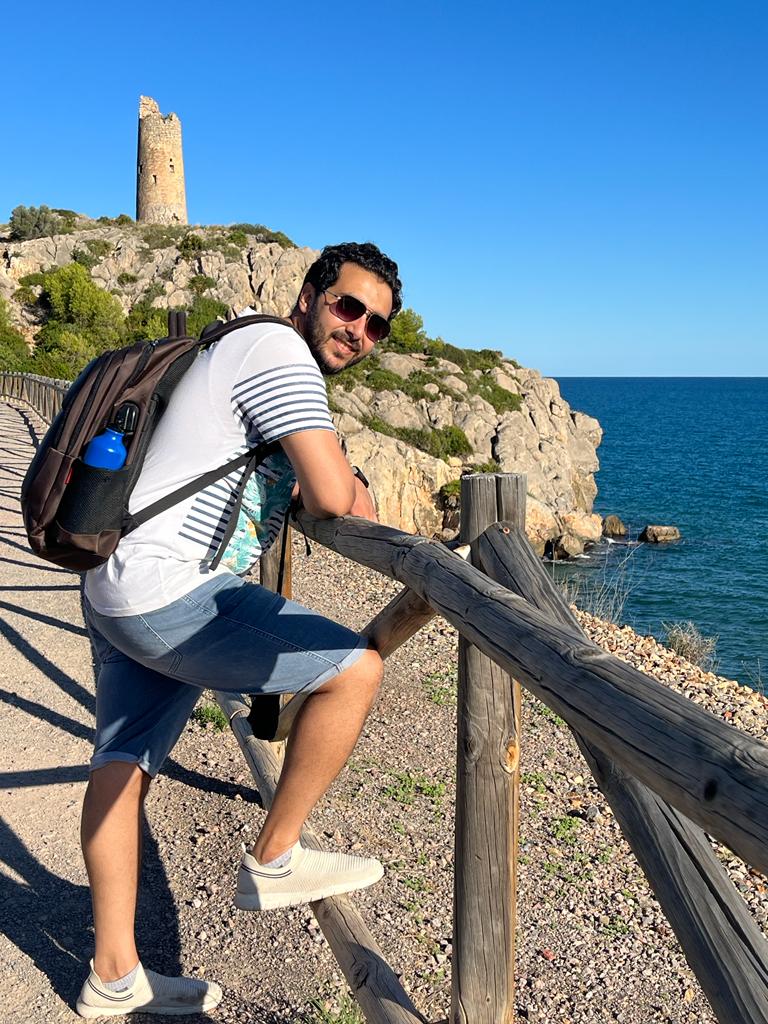
Interview with Mohamed Zahran from Universitat Jaume I (Spain), on his secondments under the supervision of Prof. Marc Landry.
First of all, can you tell us more about yourself? Where are you from, what is your university background?
Of course! My name is Mohamed Zahran, and I am originally from Egypt. My academic background began with a Bachelor’s degree in Pharmacy, which gave me a strong foundation in pharmacology and biological systems. Driven by a fascination with the brain, I transitioned into neuroscience for my Master’s degree. I am currently a predoctoral researcher completing my PhD at Universitat Jaume I (UJI) in Castellón de la Plana, Spain. In fact, I am right at the finish line.
Why did you choose this career path? What is your interest about science?
I chose this career path because the brain is the most complex frontier in modern medicine. Coming from a pharmacy background, I have always been deeply interested in how molecular changes dictate complex behaviors and psychiatric conditions. Science, to me, is about bridging that gap, finding the structural and cellular explanations for complex behavioral traits so that we can ultimately discover better therapeutic targets for human health.
Can you tell us more about your mobility? Where did you go, for how long? On what kind of research were you working on? Who did you work with? Are you planning other secondments?
As part of my research training, I completed a one-month scientific exchange at the Université de Bordeaux in France, working within the Institut des Maladies Neurodégénératives. While it was a relatively short stay, it was incredibly intensive and highly productive, allowing me to fully immerse myself in a top-tier European research environment and learn cutting-edge methodologies.
During my secondment, I worked under the supervision of Professor Marc Landry. My research focused on whole-brain functional mapping techniques ; specifically, I utilized advanced tissue-clearing protocols combined with c-Fos mapping, with the valuable support of Jérémie Teillon and Thibault Dhellemmes, to visualize whole-brain neuronal activation at a cellular level. Additionally, alongside Sandra Sanchez, I worked on Miniscope in vivo calcium imaging to track real-time somatostatin neuronal activity in freely behaving models. These sophisticated techniques have significantly enhanced both the resolution and depth of my PhD project.
Regarding future secondments, I am definitely open to them, as expanding my methodological toolkit and collaborating with international labs is vital for the progression of my research.
Same question, but for people who don’t understand a thing about neuroscience (#PsyCoMedfordummies)
In simple terms, we wanted to see how environmental factors or genetic changes alter brain wiring and lead to issues like anxiety or depression. To do this, I went to the IMN to learn a technique called tissue clearing, which uses chemicals to make an entire mouse brain completely see-through, like a block of glass. Then, using a specialized, high-tech microscope, we took 3D pictures of the whole brain. We looked at special molecule in the brain cells that turn on when a cell is active (called c-Fos). By comparing normal brains with brains missing a specific gene, we could pinpoint the exact areas of the brain that were misbehaving.
In parallel, I learned the in vivo calcium imaging technique. This involves placing a tiny, microscopic camera (a miniscope) on top of the head to watch brain cells firing in real-time while an animal moves around. It’s basically like taking a high-definition, live video of the brain in action.
What will your research bring to people and to society in general?
By mapping out exactly how neural circuits communicate and change, my research helps to understand complex brain disorders. Before we can fix a broken system, we have to know exactly how it works in detail. So, by understanding exactly where neural activity shifts in models showing anxiety, depression, and pain traits, we know the biological and structural roots of mental health disorders. Ultimately this contributes to the discovery of better therapeutic targets, helping us design highly targeted, more effective treatments for neurological and psychiatric diseases in the future.
How do you feel being part of a MSCA Staff Exchange project? What are the benefits of such mobility? What are the results of your secondment?
It is an absolute privilege to be part of an MSCA project. The MSCA Staff Exchange is incredible because it breaks down geographical and academic barriers. The main benefits are the rapid acceleration of knowledge transfer and networking. In just one month, I gained access to specialized equipment and expertise that would have taken me months or years to master independently.
The secondment was highly successful. I managed to successfully implement the brain clearing and c-Fos mapping protocols, which provided us with beautifully clear, high-resolution data of activated neural pathways. The miniscope calcium imaging data gave us a new dimension of real-time functional insights. These findings have greatly enriched my PhD thesis and will be part of upcoming scientific publications.
Do you already have future projects you want to share with us?
My immediate future project is my PhD defense happening in less than one month! Beyond that, the data we obtained in Bordeaux is part for upcoming papers.
Do you have a recommendation/an advice for future potential MSCA fellows?
My main advice is to plan your data pipeline and logistics well in advance before you go. Time passes incredibly quickly, so having a clear experimental plan and communicating with your host lab beforehand is the key to make your secondment so productive. Also it is importatnt to ensure that your home and host institutions are fully aligned on the experimental goals before you arrive so you can maximize every single day in the lab. Lastly, the human and scientific connections you make during an MSCA exchange will last throughout your entire career, so don’t be afraid to step out of your comfort zone.